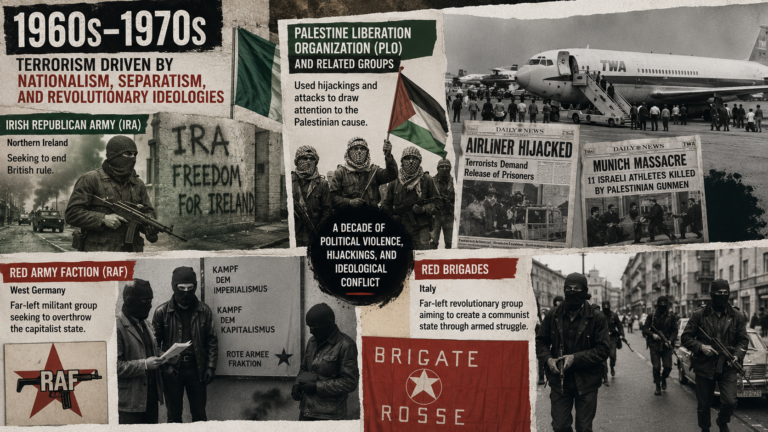
The period from the 1960s to the present is often called the Security Age because governments around the world have increasingly focused on preventing terrorism, protecting borders, expanding intelligence capabilities, and managing security threats. Terrorism evolved from largely nationalist and ideological movements in the 1960s–1980s to global jihadist networks and, more recently, decentralized extremist actors.
During the 1960s and 1970s, many terrorist groups were motivated by nationalism, separatism, or revolutionary ideologies.
Key examples include:
Characteristics:
- Aircraft hijackings became common.
- Terrorism was often intended to attract media attention.
- Governments developed specialized counterterrorism units and intelligence operations.
During the 1980s and 1990s, International Terrorism Expands
- Red Brigades Disbanded: Late 1980s; splinter groups persisted into the 1990s
- The Red Army Faction officially Disbanded in 1998. Its campaign profoundly affected West German society, prompting new anti-terrorism laws, surveillance measures, and debates over the limits of dissent.
- PLO now led by Mahmoud Abbas, the PLO remains the principal international voice of the Palestinian national movement.
- The Provisional IRA’s transition remains central to Northern Ireland’s peace and political landscape.
The 1980s saw the growth of transnational terrorist networks and state-sponsored terrorism.
Important developments:
- The Iranian Revolution influenced Islamist movements across the Middle East.
- The Soviet–Afghan War helped create networks of foreign fighters.
- Terrorist attacks increasingly targeted civilians and international interests.
A major turning point was the emergence of Al-Qaeda under Osama bin Laden.
Characteristics:
- Aircraft hijackings became common.
- Terrorism was often intended to attract media attention.
- Governments developed specialized counterterrorism units and intelligence operations.
The attacks on September 11, 2001, fundamentally transformed global politics, security, and the language used to describe political violence.
The events reshaped international relations, triggered extensive policy changes, and permanently altered how the world defines "terrorism."
9/11 and the Global War on Terror (2001–2010s)
The defining event of the Security Age was the September 11 attacks.
Consequences included:
- The launch of the U.S.-led Global War on Terror.
- Military interventions in Afghanistan and Iraq.
- Expansion of surveillance, intelligence sharing, and airport security.
- New laws allowing governments broader powers to monitor suspected extremists.
Security became a central concern of domestic and foreign policy across much of the world.