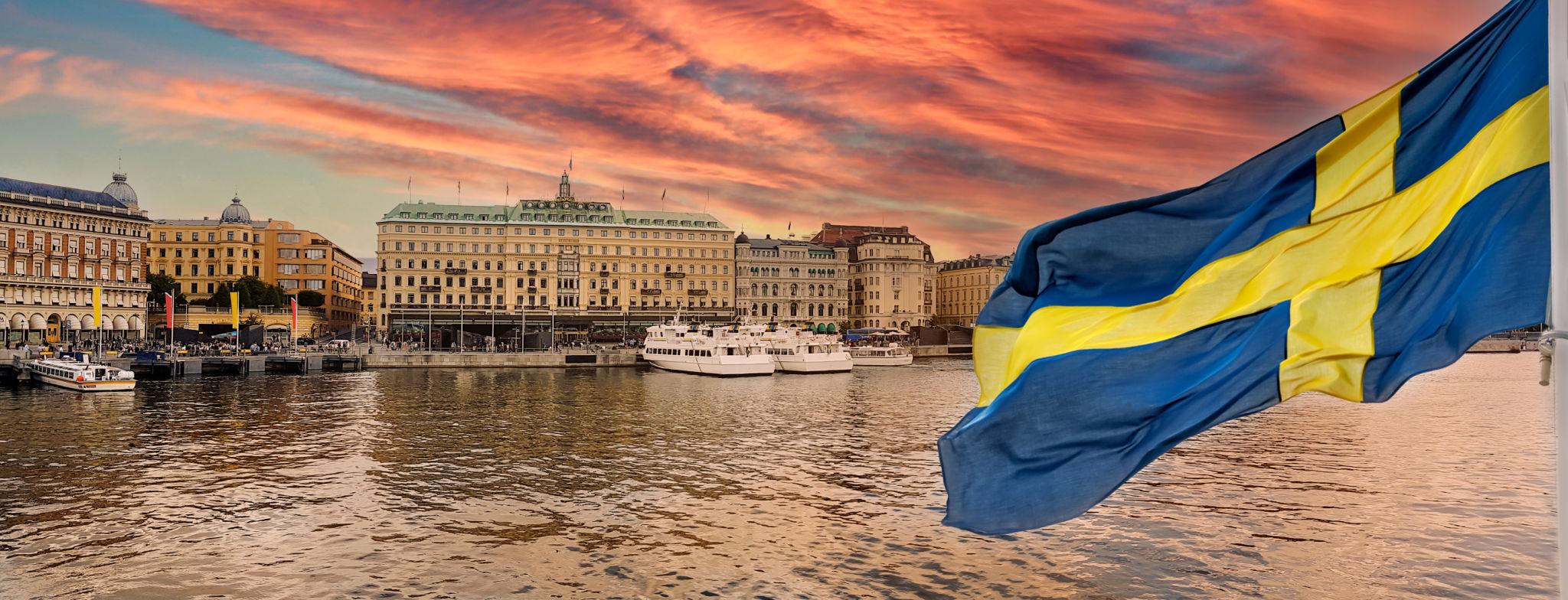
France has its protests. Germany has its political divisions. Hungary has Viktor Orbán. Italy has its arguments with Brussels. Spain has its regional tensions.
Sweden is different.
It is wealthy. Highly educated. technologically advanced. Socially liberal. Its welfare state remains extensive, and its institutions retain relatively high levels of public trust.
And yet Sweden has spent the last decade undergoing a remarkable political and social transformation.
The country's 2026 general election may have produced a narrow advantage for the centre-left, but the more interesting story is not simply who will form the next government.
It is what Swedish voters are telling their politicians about the country they want to live in. Preliminary results put the centre-left opposition ahead of the governing right by only a handful of parliamentary seats. At the same time, the Sweden Democrats — once the great rising force of the Swedish right — have suffered their first significant setback, falling from 20.6% in 2022 to around 17.6%.
That does not look like a revolution.
Perhaps it is something more interesting.
Perhaps Sweden is beginning to ask a question that much of Europe will eventually have to ask:
How do you preserve a successful society when the society itself is changing?
The Five Pillars
To understand Sweden, the election needs to be viewed through five different lenses:
History. Politics. Economics. Society. Technology.
None of them explains the country on its own.
Together, they tell a much more complicated story.
HISTORY — The Sweden That Europe Thought It Knew
For much of the second half of the twentieth century, Sweden represented something close to a political ideal.
A strong welfare state.
High taxation.
Powerful public institutions.
Strong trade unions.
Social equality.
High living standards. And a remarkable degree of social cohesion. Sweden demonstrated that capitalism and an extensive welfare state could coexist. The result was a society in which the state played a large role in people's lives, but where that role was generally accepted because the system appeared to work.
That historical background matters.
Because when a society has been successful for generations, its citizens tend to develop an expectation that things should work.
Government should work.
Schools should work.
Healthcare should work.
The police should work.
Communities should work.
And society should feel safe.
The political shock of the last decade therefore cannot be understood simply as a revolt against socialism or liberalism.
It is more accurately understood as a challenge to the assumption that the Swedish model can absorb enormous change without changing itself.
Immigration, demographic change, globalisation and organised crime have all tested that assumption.
The political argument has consequently moved from:
“How much government should we have?”
towards:
“What should the government be responsible for protecting?”
That is a very different question.
POLITICS — The Rise, Influence and Setback of the Sweden Democrats
The clearest symbol of Sweden's political transformation is the Sweden Democrats.
The party was once an outsider movement. It eventually became a major parliamentary force and, after the 2022 election, became central to the right-wing governing arrangement.
The political establishment had changed.
Immigration, integration and crime had moved from issues associated primarily with the political margins into the centre of Swedish politics.
The current right-wing government tightened immigration policy and pursued tougher measures on crime, while relying on Sweden Democrat parliamentary support.
Yet 2026 has produced a fascinating reversal.
The Sweden Democrats have lost ground.
The Social Democrats remain the largest individual party, but they too have performed poorly by historical standards. The result is therefore not a straightforward victory for either side.
And this is where the Swedish election becomes particularly interesting.
The decline of the Sweden Democrats does not necessarily mean that Sweden has rejected the concerns that created the party's rise.
Politics may have absorbed them.
The mainstream parties have already moved towards tougher positions on immigration, integration and crime.
In other words, the Sweden Democrats may have changed Swedish politics without necessarily needing to win the election.
That is an important distinction.
A political movement can lose votes while still winning part of the argument.
ECONOMICS — When Being Wealthy Doesn't Make People Feel Secure
Sweden is not a country experiencing economic collapse.
That is crucial.
Its public finances remain comparatively strong, and its economy is highly developed. The OECD describes Sweden as having solid public finances while also facing longer-term spending and investment pressures.
But prosperity does not eliminate anxiety.
Housing costs, inflation, employment, energy prices and pressure on public services can change how people experience their prosperity.
A person can live in one of Europe's wealthiest countries and still feel that the next generation may not enjoy the same security.
There is another important psychological factor.
People generally don't compare their lives with the poorest country in the world.
They compare them with what they remember.
If a Swedish family remembers a time when healthcare was easier to access, housing was more affordable, streets felt safer and social cohesion seemed stronger, then today's problems are judged against that memory.
The question becomes less:
“Are we still rich?”
and more:
“Are we still getting better?”
That distinction is politically powerful.
SOCIETY — The Real Swedish Argument
This may be the most important pillar of all.
Sweden has experienced significant demographic and cultural change.
Immigration has brought enormous benefits to the country, but integration has also presented difficult challenges.
And one issue above all has transformed Swedish politics: crime.
Organised criminal networks and gang violence have become major political concerns. Crime has been a persistent concern in Swedish public opinion and a central feature of recent political debate.
That creates a difficult question for a liberal society.
How do you remain open without becoming naïve?
How do you welcome immigration while demanding integration?
How do you maintain individual freedom while dealing with criminal organisations?
How do you protect social cohesion without turning cultural difference into a political enemy?
There are no easy answers.
And this is why describing Sweden simply as a country moving "right" is inadequate.
The Swedish public does not appear to be rejecting liberal democracy.
Indeed, Sweden continues to show relatively high levels of trust in government institutions. The OECD's 2026 survey found that Swedish citizens assessed their government's handling of complex policy issues more positively than the OECD average on most of the measures examined.
That is enormously important.
Swedes can be dissatisfied with the direction of their society without being dissatisfied with democracy itself.
They may not want to destroy the system.
They may want the system to work better.
TECHNOLOGY — The Country Where Change Happens Quickly
There is another characteristic of Sweden that is easy to overlook.
It is an exceptionally modern, digitally connected society.
That has advantages.
Information moves quickly.
Government services are increasingly digital.
Businesses are highly connected to global markets.
Technology is deeply embedded in everyday life.
But technology also changes politics.
Social media collapses the distance between a local problem and a national political crisis.
A shooting in one neighbourhood can become a national debate within hours.
A political argument can move from Sweden to the rest of Europe almost instantly.
And misinformation, foreign influence and manipulated information become increasingly important challenges.
The Swedish government itself has identified the rapid pace of technological development and foreign malign information influence as issues requiring greater resilience around the 2026 election.
The quiet country is therefore not disconnected from the modern world.
Quite the opposite.
It may be one of the countries experiencing the modern information age most intensely.
So What Are Swedes Actually Saying?
This is where the election becomes difficult to interpret.
The answer is probably not:
“Sweden has turned left.”
Nor is it:
“Sweden has turned right.”
The evidence suggests something more complicated.
Sweden appears to be moving into a period of political negotiation over what its successful model should look like in the twenty-first century.
The Sweden Democrats rose because many voters believed the traditional parties were failing to address immigration, integration and crime.
The mainstream parties responded.
Now the Sweden Democrats themselves have lost ground.
That could mean voters are satisfied with the direction of travel.
Or it could mean they believe the mainstream parties have finally absorbed their concerns.
Either way, the political centre of gravity has moved.
Is Sweden a Barometer for Europe?
Perhaps.
But not because Sweden is representative of Europe in every respect.
It isn't.
Sweden is unusually wealthy, unusually digitally advanced and has a distinctive political and social history.
Its experience cannot simply be copied onto France, Germany, Ireland or Spain.
But Sweden can act as an early warning system.
It demonstrates that economic prosperity does not automatically prevent political dissatisfaction.
It demonstrates that a society can remain democratic and institutionally strong while simultaneously becoming anxious about crime, immigration, identity and social cohesion.
And it demonstrates that populist parties do not necessarily have to win elections to transform the political debate.
That is a lesson many European countries should take seriously.
The Quiet Revolt
Perhaps "revolt" is even the wrong word.
Swedes do not appear to be rejecting their society.
They appear to be arguing about what they want their society to become.
That is much more subtle.
And perhaps much more important.
Because the Swedish story isn't really about left versus right.
It is about continuity versus change.
It is about whether a society built on trust, openness, equality and a strong state can adapt to immigration, globalisation, technology and new forms of crime without losing the characteristics that made it successful.
That is not merely a Swedish question.
It is a European question.
And perhaps that is why we should pay more attention to the country that rarely makes the headlines.
The loud countries tell Europe what they are angry about.
The quiet countries may tell Europe what is coming next.
The D view
Sweden should not be dismissed as a peripheral European story.
Nor should its election be reduced to another victory or defeat for the political left or right.
The more revealing story is that a wealthy, stable and highly functional society is wrestling with questions that are appearing throughout Europe:
Who belongs?
What does integration mean?
How much change can a society absorb?
What does government owe its citizens?
And can economic prosperity compensate for a loss of security or social cohesion?
Sweden may not yet have the answers.
But it is asking the questions.
And that may make this quiet country considerably more important than it first appears.